

The following excerpt is chapter 12 from the book A Nourishing Perspective: Reconnect with Your Inner Voice and Harmonize Your Relationship with Food by registered dietitian Lee Cotton.
Follow FLEETSTREET on Instagram and TikTok.
The fact that most diet plans do not incorporate mindfulness practices or your emotional and physical makeup into their strategies should tell you everything you need to know about diet culture.
To clarify, the goal is to have you experience a certain level of success that gives you hope. Next, the intent is to have you level off so that you have to continue to try harder and harder to achieve your goals. Lastly, when you fail to achieve them, the goal is for you to seek another remedy and spend more money. As discussed in chapter 1, the food and diet industry is a business, and the goal is to perpetuate the cycle of dieting and un-dieting rather than help you cultivate a positive body image through the power of mindful nutrition.
This is why nutrition and mental health are often treated as separate entities in the medical industry. As most people who’ve ever gone on a diet (including myself) can attest, having the “perfect” nutrition plan will never magically heal the emotional wounds of low self-image.
Think of diet culture this way. Imagine you’re ready to climb a mountain and you have everything you need for the journey. You’re strong and healthy. You’ve purchased all the tools. You have great companions that are there to support you along the way. You’ve done all the necessary training, but there’s just one problem.
Strapped to your feet are 100-pound boots. Despite having the desire, the ability and the resources to climb that mountain, when you head toward the summit, you find yourself unable to get to your destination.
This is the essence of diet culture. You receive the tools to move from point A to point B, but you can’t get very far because of the boots – the emotional component – that are holding you back.
The best-selling health and wellness books in Canada.
Removing the boots
In my observations with patients, I’ve seen how effective mindfulness practices can be at helping them remove the metaphorical boots when they are taught how to cultivate positive thoughts about both themselves and food.
For example, one individual may begin nutritional therapy by thinking that they’re incapable of making a significant change in their relationship with food because they’ve struggled for years. For as long as they can remember, hardship is all that they’ve ever known. But once they realize that they need to take off the metaphorical boots, a shift happens.
Mindfulness reveals what we’re feeding our minds and how these thoughts are affecting us.
In my own life, mindfulness taught me that I felt envious of other people who seemed to enjoy food in a way that I couldn’t. I became jealous, thinking that they were stronger or somehow better than me.
But that wasn’t the case at all. Those thoughts were just my boots. The problem wasn’t with everyone else; it was that I was feeding my mind with thoughts that inhibited my own progress:
- “I’m not as strong as others are.”
- “I’m not ready to make this kind of change in my life.” • “I can’t sustain this long term.”
- “I’m too old to change now.”
- “I don’t have enough willpower.”
One of the keys to healing our relationship with food is our ability to change what we’re thinking.
Why is this important? Fundamentally, it’s because our thoughts influence our emotions, and our emotions drive our actions. In order to make changes to one’s emotional state, an individual first needs to identify their thought patterns and perceptions that are influencing the way that they feel.
For example, I’ve worked with clients before who were totally unaware of how they felt and why they were engaging in certain eating disorder behaviours.
How to stop thinking about something and get your brain to relax.
Identifying your inner thoughts
To identify your thoughts, start with what’s referred to as your “mind’s eye.” Your mind’s eye is your capacity to see what’s beyond the physical plane and into your current circumstances. Think of it as your insight. Your physical eyes see what’s in front of you; your mind’s eye (or insight) sees what’s inside you. Right now, try the following mindfulness exercise:
- Take a deep breath, breathing through your nose while allowing your abdomen to expand and retract.
- Using your mind’s eye, focus on your last thought.
- Allow the thought to come fully to the surface.
- Next, acknowledge any feelings associated with the thought.
- Release the thought on an exhale without any judgment.
- Come back to the breath.
Repeat this cycle as many times as you wish throughout your day. For now, though, a good number to start with is four times a day. This will help you cultivate the habit of interrupting habitual and intrusive thoughts that disrupt your innermost thoughts.
Kylie Jenner, ASMR and sound baths: Is sound a meditation cheat code?
Being an impartial observer
One of the most important parts of mindfulness is learning how to become an impartial observer of your thoughts.
When a spontaneous negative thought enters your mind, remaining neutral, positive and calm will help you maintain your emotional stasis (or balance) during these distressing moments.
For example, if you feel an intrusive thought enter your mind, immediately pause what you’re doing, connect to the breath, and acknowledge the thought with love and gratitude.
Remember, though, that challenges in life are part of the human experience. Life is not perfect, and there is no pressure for you to be either.
The stressed-out newbie’s guide to meditation.
Cultivating inner piece
Peace is not something that is found, nor is it achieved like a goal. Peace is cultivated through practice and mindful awareness of our thoughts.
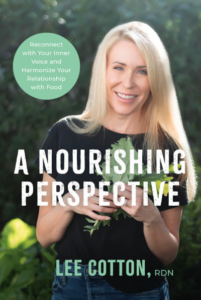
Lee Cotton, RDN, LDN, is a nationally recognized licensed dietitian and founder of Lee Cotton Nutrition. She is known for delivering evidence-based nutrition education through major media outlets: WPTV, WFLA, Martha Stewart, Prevention, Reader’s Digest, Oprah Daily, Parade and Fox News. Her book, A Nourishing Perspective: Reconnect with Your Inner Voice and Harmonize Your Relationship with Food, has received praise from Woman’s World Magazine, Publisher’s Weekly, Kirkus Reviews and the Palm Beach Post.