
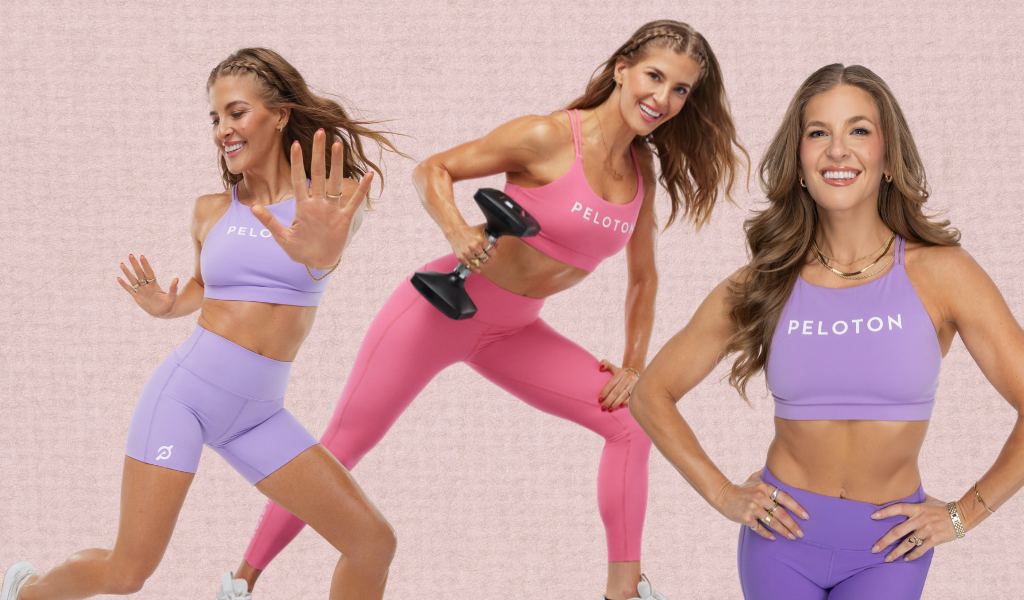
Lately, I’ve been leaning into what my body wants for a workout. Not in the “couch vs cardio” approach, as we both know where I’d be if I asked myself between the two. But how do I want to feel after my workouts? What do I need to address, whether that’s a muscle pump or a heart pump, a posture tweak, fix some kinks with stretches, calm my mind, the eff down? And I’ve noticed that I’m reaching for my Peloton app, filtering classes with instructor Rebecca Kennedy.
I find her instruction is so specific that I can’t help but mentally picture what the moves do in my body to feel it even more, from quad stretches, glute-engaging squats to the most incredible shoulder release on the foam roller. I had the chance to sit down and talk to her, with Peloton’s new treadmills beside us (she was in Toronto to promote them, and a review to come!). And that meant I got to ask her more about how she has the ability to instruct in a way that deepens my understanding of my body, and get her tips for listening to yourself better.
How to use intuitive training to listen to your body.
How do you bridge that gap between following a structured plan and actually listening to your body?
I’m a Jack of all Trades. I generally value a holistic approach to my fitness. I don’t think that only leaning into one thing makes me feel good, move well, and be my fittest self. And quite honestly, I treat it kind of like taking supplements.
Pilates: I don’t do it all the time, but I know how incredible it is for my pelvic floor, for my stability and my coordination.
Strength training, which is my meat and potatoes, is my favourite thing. It really grounds me, helps build muscle, and builds my stamina. It really is where I feel my most confident and alive, and most like myself.
For bone density, I like low-impact cardio. It feels like a party, and it brings me back to my aerobic and dance days, which that type of workout is mostly for “zone two” and my mind.
When it comes to all of the tread stuff I do, I like that I can feel really athletic. I love hiking. I love walking. I think it’s one of the healthiest things you can do, and it’s a low barrier to entry, and we can hopefully do that for the rest of our lives.
So mix all that in with the mobility and stretching content, and that is where I stay injury-free.
“You have to give yourself that opportunity to win.”
I’ve been injured more than I’d like to admit. And every single time, I learn something from it. I learn to prioritize my recovery as much as I do all of my training. It’s equal.
If I want to be able to lift really heavy and move really fast. Then I need the ability, the flexibility, and the mobility to support that.
That’s probably why I like to show people that you can have a really robust way of training. It’s very varied. It keeps you connected to what you’re doing, and makes it really fun.
Our body has an innate intuition. And you want to be able to have enough awareness or a relationship with your body so that you know not just what it wants but what it needs.
Mind the healthcare gap: From injury to working out like normal.
How do you balance between being lazy and inconsistent with leaning into what your body needs?
Having a game plan is really important. That’s where a lot of people get held up, which is why HILIT (high intensity, low impact), HILIT+, and our other programs do really well. It takes the guesswork out of it for you, and it provides you with the framework, which we all need: systems.
Our brains work in different ways. We can all be very busy, and you don’t need to be a fitness trainer to be able to curate a training program for yourself.
Ask yourself: What is your goal?
If you want to run a marathon, you’re going to take the marathon training program. If you want to have a if you want to compete in Hyrox, you’re going to take the Hyrox program.
If you don’t mind repeating things, we have splits, which is honestly, I think, the best way to train.
So, taking out one of the hurdles is the best way to get started. Then it’s going to come down to discipline and consistency, because there are days that, you know, we are tired and we would rather sit out. You have to give yourself that opportunity to win.
Not gonna work out? Peloton’s Camila Ramón will get you motivated.
For someone who isn’t intuitive, how can they look for workouts/programs that help with that? What are the tells for being physically and mentally tired?
That’s a good question. If I’m having trouble focussing, or if I’m feeling a little bit of brain fog, and I’ve been staring at a computer or a screen all day, I know I need to just close my eyes for a second, and I can usually pick myself back up.
Taking a bit of a nap, closing your eyes, meditating; that should usually clear up a lot of the brain fog.
If there’s systemic fatigue, where I’ve pushed my body too much without ample recovery, or I haven’t been able to process that through my body yet, it almost feels like the weight is too heavy to lift, and it’s hard to move. If you give yourself five minutes and do a warm-up on the floor or do five minutes of walking, mobility or anything like that, and you’re still not awake, that’s your sign for recovery.
Get to know your body, but those tells are really helpful.
Aidan Faminoff and Hazel on being highly competitive.
How do you avoid burnout?
You learn this skill by burning out enough times that you have enough evidence or data to look back and support that. But it’s also recognizing when we say yes too often, we load our plates with too much; we look at what we’re doing and how much life stress we have.
Your body doesn’t know the difference between the physical stress from a workout and having a really stressful week at work or at home in your relationship. It is going to process either the exact same way.
Fitness trends for the new year: A mix of strength and recovery.
After a handful of years embracing the Pilates trend, I’m feeling the urge for more intense cardio. Are you finding a return to heart-pumping workouts with users? Or is it just me? Ha!
Pilates isn’t going anywhere. You know, we see even more people taking it. And the crazy part is that a lot of reformer studios are transitioning to mat-based classes, which is what we already do. Pilates mat classes are very challenging, but they’re also incredibly effective.
But we’re talking about more than just two different types of people and how you like to work out. Not to say that runners don’t also do Pilates or Pilates people don’t run. But just like there are introverts and extroverts, there are people that like to take yoga, and there are people that like to go hard on the bike. I think it’s becoming a personal preference.
I do see overarching booms in the fitness industry, especially looking for community. The craving right now is connection. And what we’ve seen with our members is that they’ve created their own crews.
Run clubs are huge right now. We have our Peloton run club in New York City, and we also have all of these member-created communities that fly in from all over the country, meet each other in New York City, and come take class together. It’s dope. I love it so much.
“Your body doesn’t know the difference between the physical stress from a workout and having a really stressful week at work or at home in your relationship. It is going to process either the exact same way.”
From grip socks to glam: How to nail the Pilates Princess aesthetic.
How do you get that mind-muscle connection? Your instructions are so precise.
It goes back to being a dancer. The things you learn growing up, you don’t realize how much you’re going to use them later on. But it’s every little nuance from our ballet teachers, like “Your hip dropped one inch,” or it’s like, “If you slightly tuck, do you feel this open and this close?”
I know when I’m feeling my SI (the sacroiliac joint), I need to actually loosen up or get more connected in my ribs, and you know, release the psoas (hip muscles).
It’s really helpful to be able to communicate that, and then play around, because there are really – I’m not going to lie – shitty foam roller exercises that exist that could get the job done.
It’s about actually creating meaningful release or immediate change. And how can we actually do something that’s a little bit better and try to figure that out?
Resolved to run? Think wisely about body image.
… and figure out if you really do need to sit on the couch?
Sometimes I want to just sit on the couch, but what my body needs is for me to actually get up and go for a 15-minute walk.
Then there are really structured things that you need in there, too, so it’s not just at your whim. But if there’s a day you are set to lift super heavy and do like a 10 out of 10 workout, and you’re not feeling it that day, then by all means listen to your body.
But having structure is really important. That’s a skill you develop by moving your body more often.